Why a Cropped Photograph Can Change the Story
A cropped photograph can redirect attention and hide context. Use this simple viewing routine to compare the frame with what may sit just outside it.
The most common mistake with a cropped photograph is treating its edges as natural boundaries. A tight frame can make a person, object or gesture seem to be the whole story, while the missing surroundings would change how you read it. To understand a cropped photograph, compare what the image shows with what its edges exclude.
You do not need the original file to do that. A short routine across a week can help you notice framing choices in news images, adverts, social posts and personal photographs, then describe their effects without claiming to know what the unseen scene contained.
A week of looking
Choose one image a day from a source you already encounter: a newspaper, a shop window, a museum page or a social feed. Save the image or note where you saw it, then ask what first caught your eye. Record a few visible details: the central figure, the direction of a gaze, a bright patch, a hand at the edge, or a line that leads towards the subject.
Keep the exercise focused on the frame, not on guessing the photographer’s intention. Cropping can result from editorial selection, a layout requirement, a phone screen or a repost. The visible effect is easier to discuss than the reason it was made.
- Day one: Notice the subject’s position. Is it centred, pressed to an edge or partly cut off?
- Day two: Look for people and objects that are included only in part.
- Day three: Follow the subject’s gaze, gesture or movement towards the boundary.
- Day four: Check which details appear sharp, bright or visually prominent.
- Day five: Look for signs of place: a doorway, sign, table, pavement or landscape.
- Day six: Compare the image with another version, if one is readily available.
- Day seven: Write a short account of what the frame emphasises and what remains unknown.
A few words in a note app are enough. The point is to build a habit of observation, not to assemble a catalogue of images.
What the frame directs
A crop can steer attention by placing one detail near the centre, enlarging it relative to its surroundings, or removing competing information. A face close to the edge may feel crowded. A hand entering from outside the frame can draw attention to an unseen person or action. A large empty area can make a small subject appear isolated, even when the wider scene might be busy.
Read these effects as visual choices, not proof of a particular mood or motive. For example, a close view of a discarded cup may foreground litter; a wider view might also show a pavement café, a bin or the person carrying it. The crop affects what can be considered, but it cannot tell you what the omitted context would have been.
On one day of your routine, cover the image caption and spend a moment describing only what you can point to. Then read the caption and notice which details it asks you to connect. This separates the photograph’s visible evidence from the explanation supplied alongside it.
Edges and omissions
The boundary is often where the most useful questions begin. Scan each edge slowly rather than staring only at the subject. Look for a partial sleeve, a shadow, a reflection, a cut-off sign or a surface that continues beyond the picture. These clues may suggest what is nearby, but they do not reveal the whole scene.
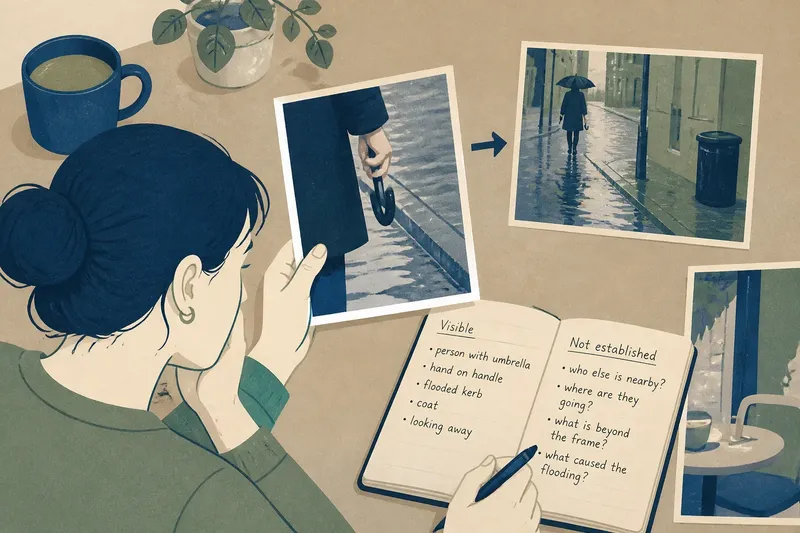
Make two brief lists: visible and not established. Under visible, write facts such as “a chair is partly in frame” or “the person is looking left”. Under not established, put questions such as “who is beside them?” or “what is the sign attached to?” Keep questions as questions; do not turn them into claims.
Say you see an image of a person holding an umbrella beside a flooded kerb. The frame contains the umbrella, the person and a strip of water, but no building entrance. You might note that the crop foregrounds the person’s exposure to the water; you cannot tell from that view alone whether they are entering a shop, helping someone or passing through.
Finding another frame
If the image matters to a decision or a discussion, look for another presentation before settling on an interpretation. Check the original page, a photographer or publisher’s caption, a gallery view, or a version displayed at a different size. A wider image may add setting; a different crop may shift attention to another person or object.
Compare versions in order, rather than relying on memory. Put them side by side where possible and ask:
- Which subject becomes larger or more central?
- What appears or disappears at each edge?
- Does the relationship between people or objects change?
- Does the caption describe the same visible action in both versions?
Do not assume that the widest version is automatically the truest. It may include more surroundings but still omit something important, and a tight crop can be useful when the subject is clear. The practical question is what each version allows you to see and what it leaves unsettled.
Questions about cropped photographs?
Can a crop change the meaning of an image?
Yes: removing or enlarging visual details can alter what attracts attention and how subjects appear related. It changes the information available in the frame, though it does not by itself establish why the crop was chosen.
How can I tell whether a photograph is cropped?
Look for an available wider version, a visible crop boundary in a layout, or details cut off at the edges. Without another version or source information, you may be able to notice tight framing but not confirm how the image was originally composed.
What should I do if the original image is unavailable?
Describe the visible details and separate them from the unanswered questions. Avoid filling missing context with a confident story, especially when the image is being used to support a claim about a person or event.
Does a wider photograph show the whole context?
Not necessarily. A wider frame includes more surroundings, but it still has boundaries and may leave out relevant people, actions or earlier events.
Writing a careful reading
At the end of the week, choose one image and write three sentences. First, describe what is plainly visible. Next, say what the crop makes prominent. Finally, name one piece of context you would need before making a stronger claim. This format is useful in a classroom, a group chat or a conversation about an image used in an advert.
For instance, you could write: “A person stands beside a doorway, with one hand raised near the frame. The tight crop draws attention to the gesture and the threshold. The image does not show who is inside or what happened immediately before this moment.” That account remains informative without pretending the missing scene is known.
Use the same discipline when sharing an image. Keep its caption and source with it where practical, and make clear when you are describing an interpretation rather than an observable fact. A cropped photograph can change the story a viewer imagines; checking its edges helps you see where the photograph ends and your assumptions begin.