The Handle That Tells You How to Use an Object
Learn to read a handle’s shape, placement and grip to see how an object is meant to move, and choose the right kind of control for the task.
The common mistake with a handle is to treat it as decoration or a convenient place to grab. Read its shape and position instead, and it can tell you whether an object is meant to be lifted, pulled, turned or carried; ignore those clues and the object may feel awkward or invite the wrong movement. A handle’s shape, placement and grip are clues to use, not proof of a designer’s intention.
Start with the movement
Before judging a handle, look at what the object itself must do. A drawer moves along a track. A kettle is lifted and tilted. A tap control turns or pivots. The handle’s relationship to that movement is more useful than its style alone.
Ask where the force needs to go. Pulling a drawer calls for a grip that draws the hand towards the user. Carrying a basket calls for a grip that lets the hand support its weight from above. Turning a small control calls for contact that can apply rotation without asking the whole hand to wrap around it.
Then notice the direction of the handle. A horizontal bar on a drawer front invites a horizontal pull. A loop above a container suggests lifting. A short knob or lever on a tap points towards a turning or pressing action, though its exact movement may depend on the fitting.
Use the object’s movement as your first clue; let the handle refine the reading.
If you need to pull
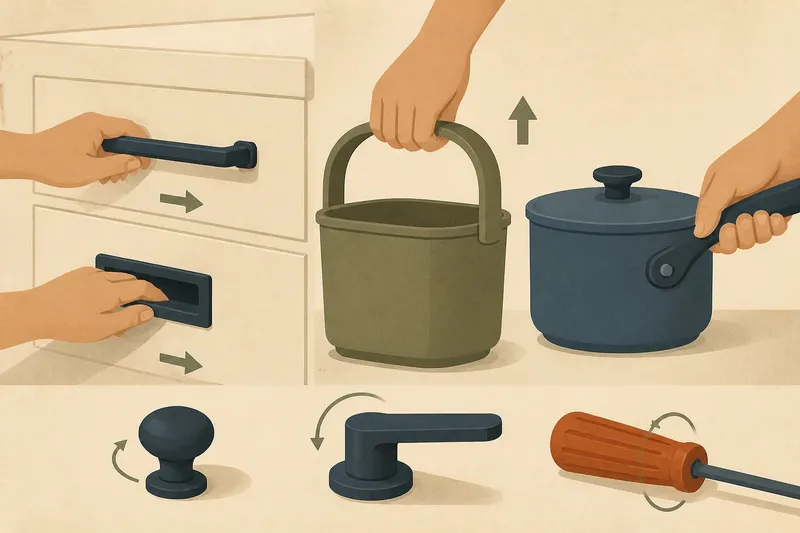
For drawers, cupboard doors and sliding panels, a handle is most legible when it gives the fingers somewhere to hook or the palm somewhere to press. A projecting bar or curved pull leaves space behind it for a grasp. A shallow recessed grip asks the user to place fingertips into a hollow and draw outward.
These forms suit different settings. A projecting pull is easy to find by touch and can be grasped from several angles, but it stands out from the surface. A recessed pull keeps the front visually flatter and avoids a protrusion, but it depends on the recess being large and clear enough for the intended hand.
Placement matters just as much. A pull near the edge that moves often gives the hand a direct route to the opening. A handle centred on a small door can make the action feel balanced. If a wide cabinet has two pulls, their spacing may signal that the door is meant to be opened with both hands or by either side.
Say you are choosing between a recessed groove and a projecting bar for a frequently used kitchen drawer. If the drawer front sits close to another surface, the groove may keep the front unobstructed; if you want a grip that is easy to locate without looking, the bar may communicate the pull more clearly.
If you need to lift
For a jug, saucepan or shopping basket, look for a handle positioned to support the object as its weight leaves the surface. A loop above a vessel usually invites the hand to lift from the top. A side handle on a saucepan can let the user raise and tilt it while the other hand steadies the body or lid.
Grip shape changes the message. A broad loop can accommodate fingers together or a hand through the opening; a narrow straight handle suggests a more contained grasp. A handle with a curved or offset profile may make room for knuckles or keep the hand away from the object’s body. Those cues say something about how the object is meant to be held, but comfort depends on the user and the load.
Also check whether the handle is positioned to keep the object balanced during the intended movement. A carrier handle placed above its centre can encourage an upright lift; a side grip may make tilting easier. Neither arrangement is universally better: the useful form depends on whether you need to carry, pour or transfer the contents.
If you need to turn
Turning handles appear on taps, oven controls, door knobs and hand tools. A round knob invites a whole-hand grasp and rotation. A lever gives the hand a longer point of contact, making its direction easier to read: move it down, up or sideways, depending on the fitting.
On a tool such as a screwdriver, the handle’s length and cross-section suggest how the hand should apply force. A rounded grip supports a turning motion, while a flatter or shaped section can help orient the tool in the palm. On an everyday control, a small ridge or notch may help the fingers identify its position without requiring close attention.
Do not assume that a familiar shape means a familiar action. A lever can pivot in different directions, and a knob may push as well as turn. If movement is unclear, look for a symbol, a stop, or the object’s operating instructions rather than forcing the handle.
What does the handle suggest?
What does a loop handle usually signal?
A loop commonly offers a place to lift or carry, especially when it sits above a container or basket. Its opening also shows how the hand might enter, though the object’s weight and balance affect whether that grip is comfortable.
Why is a handle placed near an edge?
On a door or drawer, a pull near the moving edge can make the direction of opening easier to understand and reach. On a carried object, placement may instead relate to balance, so read the handle alongside the object’s shape.
What does a recessed grip communicate?
A recess suggests that fingertips should fit into the surface and pull, rather than grasp a projecting part. It can suit a clean, low-profile front, but a shallow or crowded recess may make the action hard to read.
Can a handle be misleading?
Yes: a decorative bar may not move the part it appears to control, and a shape can be chosen for appearance or manufacturing needs as well as use. Treat form as a prompt to inspect the object, not as an operating instruction.
Choose by the situation
When comparing objects, match the handle to the action you expect to repeat:
- Frequent opening: favour a clear, easy-to-locate pull if the surrounding space allows it.
- A flat front: consider a recessed grip, then check that fingers can reach the hollow comfortably.
- Carrying a container: look for a handle above or beside the body that supports the way you intend to lift it.
- Pouring or tipping: consider whether the grip gives you control over the tilt, rather than merely offering somewhere to hold.
- Adjusting a control: choose a shape whose direction and contact point make the intended motion legible.
When the right choice depends on a product label, manufacturer instructions or local rules, follow those rather than relying on the handle’s appearance.
The handle is one part of an object’s visual language: it gives a useful first reading of movement, while the body, balance and controls complete the message. For a quick reading, imagine the hand approaching the handle and trace the movement it would make next. If that action is clear and fits the task, the form is communicating well.